Gen Z and Millennials are experiencing a mental health crisis. A study conducted in 2020 showed that Gen Z and Millennials are experiencing depression and anxiety symptoms as double the rate of Gen X and triple the rate of Boomers. As a result, Gen Z and Millennials are found to be coping with substances like alcohol at higher rates than older generations.
Are younger generations simply weak or fragile? I don’t think so. Gen Z and Millennials faced unique challenges during their childhoods and coming of age years. The prolonged stress while young has led these generations to struggle with mental health at unprecedented rates.
The United States, and the world at large, have faced several collective traumas in the past 25 years, impacting Gen Z and Millennial early development. We are going to specifically look at the impact of 9/11, school shootings, and social media on people born between the years of 1981 – 2012.
Never Forget
September 11, 2001 is a date that Americans will remember for generations to come. The United States was attacked by terrorists whose goal was to demolish the beacon of hope America stands to be for many across the globe. How old you were when this attack happened impacted how you responded to it.
Boomers and Gen X were generations old enough to fully understand what was happening when the Twin Towers were attacked in 2001…
Well, to the best that anyone could understand such a horrific event. This understanding of the crisis at hand diminished the trauma response experienced for many Boomers and Gen Xers.
(Dr. Dan Siegel has research on the importance of understanding your experiences to decrease trauma responses but I cannot find the article where he speaks about this. The problem with being as obsessed with research as I am so that I know some things but I have no idea where I learned it. You’ll just have to trust me on this one.)
Between the ages of 21 and 46 at the time of the attack, these were also generations that experienced agency after the attacks – they enlisted in the military, voted for politicians that fit their interests, and raised money for causes that were important to them.
Millennials had a different experience.
I was six years old in 2001. I remember not being allowed to go outside, yet the whole school was in the gym for a mid-day recess – usually unheard of. Teachers huddled around a television while we were told, through tearful breaths, to go play. My parents kept my sister and me in our rooms once we got home, taking turns to sit with us and check on us, while the other would watch the television downstairs. The word “terrorism” was introduced to the Millennial lexicon. Fear and anxiety became part of our generation’s fabric.
Gen Z is too young to remember 9/11, if they were even born yet. Yet, in their earliest experiences, they were surrounded by fear and terror. We are starting to understand how impactful the first two years of life are to overall human development – Being born the year of a terrorist attack or in the aftermath of war that followed set this generation up for distress and anxiety.
Thoughts and Prayers
In 1999, the first school shooting in the United States took place at Columbine High School. 15 people were killed.
The next major shooting was in 2007 at Virginia Tech. 32 people were murdered.
These shootings happened periodically until 2012, when a gunman opened fire at Sandy Hook Elementary School, killing 20 children and six adults. I was 17 years old at the time of the shooting, a senior in high school on the other side of the state of Connecticut, still too close for comfort. I stayed in my AP English teacher’s classroom, crying, making it to my next class a little late.
When I arrived at my Physics class, I tried to tell the teacher what had happened. He told me to sit down, and he kept teaching. I sat in the back of the room in a state of shock while he wrote formulas I did not care about on the board.
I don’t remember any social workers, counselors, or trauma responders being present at school the following days – Maybe they were there, but I didn’t speak to them.
In 2018, 17 people were killed at a high school in Parkland, Florida. After the shooting, Gen Z took to the streets – they spoke to their local leaders, they did television interviews, and they fought for the right to go to school safely. These kids were largely mocked and ridiculed by older generations for their values and self-advocacy efforts, some even being accused of being crisis actors.
The events I mentioned above are not an exhaustive list of school shootings in the United States over the past 25 years. Just the “major” ones. How sad for us.
Millennials and Gen Z grew up with a unique fear of being killed at school.
School – A place of learning and discovery – became a place to fear. And, once again, we lacked the agency to cause the change we so desperately wanted and needed. Just as with 9/11, Boomers and Gen X had agency over their actions and our government, while Millennials and Gen Z took (somewhat hopelessly) to social media to raise awareness.
Nearly 350 school shootings were reported in 2023. #thoughtsandprayers
When the Bullying Never Ends
I’m sure you’ve heard how looking at our own faces and the filtered faces of others is impacting our mental health and self-esteem, especially the self-esteem of those of us who were young when social media began to make its rise in the 2000s and 2010s.
What I’d like to focus on is a more personal experience that I had a younger person with social media – Cyber bullying.
In 2024, 64% of young adults between the ages of 18 and 29 reported experiencing cyber bullying in their lifetime.
When I was in middle school, I was bullied from the second I walked in the building until I left the property at the end of the day. My only reprieve was when the anxiety hurt my stomach so badly that I had to go to the nurse. In 7th grade, teachers stopped believing I was sick and wouldn’t allow me to go to the nurse’s office anymore, taking away my only break during the day.
When I got home, the bullying didn’t stop. I would receive messages via AIM and Facebook (am I aging myself?) with the same taunts and threats that I was receiving during the day at school.
You may be thinking, “Why didn’t you just not go online?”
Because I was 12 and that did not seem like a reasonable option to my developing brain. Social media was a part of the social fabric of my generation. Missing something that happened online after school felt like a burden I could not stand to carry at that age.
Or maybe you’re asking, “Why didn’t you tell an adult?”
I promise you, that would have made things much worse – Add snitch to the list of names they called me? No, thank you.
The problem has only gotten worse for our youngest citizens with the help of handheld devices. When I was 12, I had to log onto the family desktop to use the internet. When my mom told me to get off for the night, I had to get off. Younger generations who are experiencing cyber bullying via social media have no breaks – their devices, and their bullies, are in their hands, non-stop.
Final Thoughts
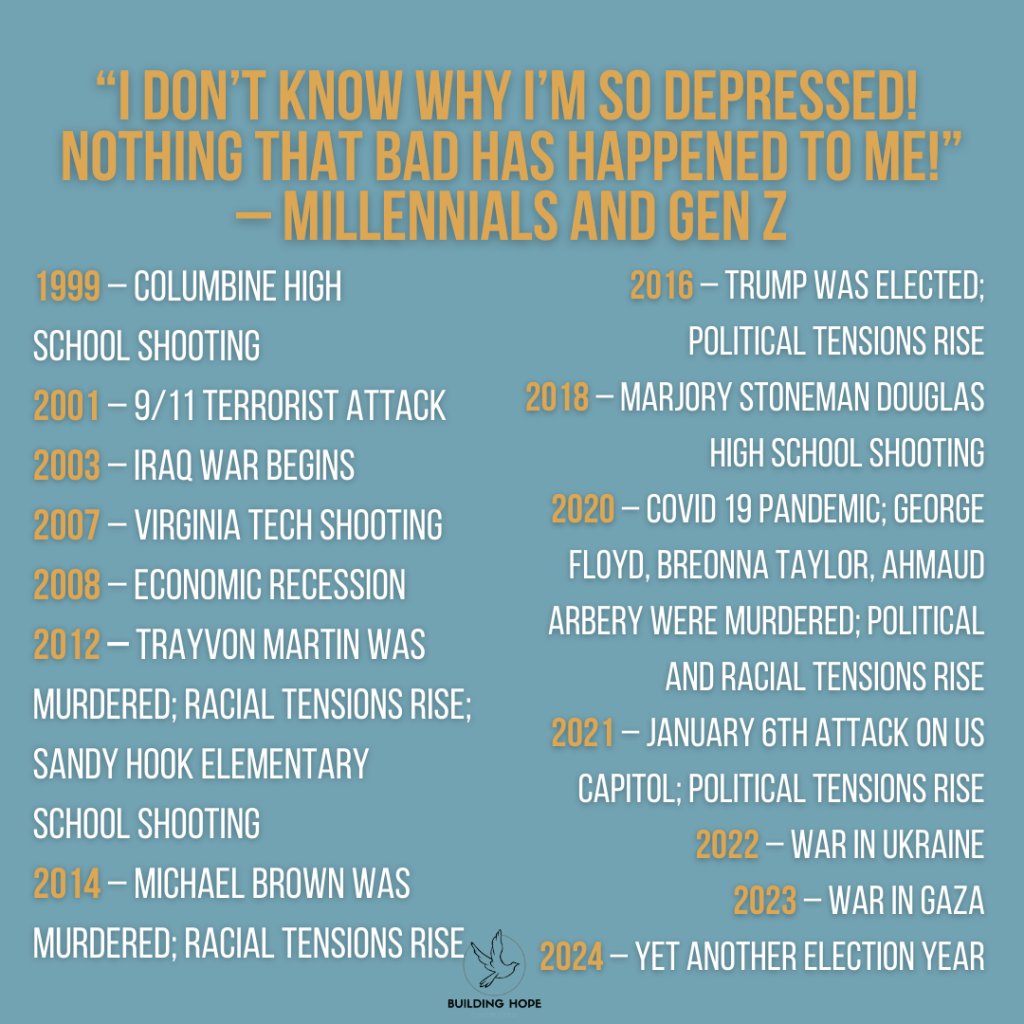
My clients, friends, and family know that I can talk about the collective trauma Millennials and Gen Z have faced over the past 25 years ad nauseum. However, blog posts can only be so long, so I’ve shorted my Millennial therapist rant to 3 events – 9/11, school shootings, and the rise of social media.
Events I didn’t mention include the police killings of Michael Brown, George Floyd, and Breonna Taylor; the rising political tension in our country and our world; the economic recession of 2008; COVID-19; and the impact of global warming.
So, the next time someone insinuates that Gen Z and Millennials are weak, remember this –
There’s nothing wrong with us. We are reacting just how bodies react when stressful events happen, and happen, and happen again. It’s the situations that are abnormal, not our reactions.

 Building Hope Counseling Services
Leave a comment