Domestic violence impacts millions of people in the United States each year, whether they are being abused, know someone who has been abused, or are abusive themselves (Center for Disease Control and Prevention, 2022). Domestic violence and abuse do not refer solely to physical injury – It can include verbal, emotional, psychological, technological, and financial tactics as well (Domestic Violence Ended, 2023). Abuse causes a power imbalance in a relationship by causing harm to the victim and a privileged status to the abuser (Bancroft, 2002). Abuse itself is not the end goal for the abuser and they may not even see themselves as being abusive. The goal is power and control over their partner.
Over 61 million women and 53 million men have experienced domestic violence via psychological aggression in their lifetimes (Center for Disease Control and Prevention, 2022). The highest risk of injury to women in the United States is currently intimate partner violence, and it has been for decades (World Health Organization 2021; Bancroft 2002). There is less research regarding LGBTQ+ relationships (thanks, heteronormativity, and homophobia, alive and well in 2023), but research does suggest that the LGBTQ+ community experiences domestic violence at equal, and sometimes higher, rates than their heterosexual counterparts, with bisexual and transgender persons being most at risk for victimization (National Coalition Against Domestic Violence, 2018).
If you or someone you know is in an abusive relationship, you are not alone. Please reach out to the National Domestic Violence Hotline at thehotline.org or 1-800-799-SAFE (7233). For more information on domestic violence, I highly recommend Why Does He Do That?: Inside the Minds of Angry and Controlling Men by Lundy Bancroft (2002). Skip straight to the end of this post for a list of national and Massachusetts based resources for victims and survivors of domestic violence.
The Trap
The beginning of an abusive relationship often seems like a magical fairy tale (Bancroft, 2002). The abuser may be charismatic, generous, or gregarious. They may be well known and well liked in their community. They may be exactly who you have been looking for this whole time. Unfortunately, this romantic daydream will not last for long if you have fallen for an abuser.
A common question about abuse is “Was their plan to be abusive all along?” While that is not a simple answer, Bancroft argues that usually, no, the abuser is not intending to be abusive at the beginning of the relationship (2002). The abuser wants an idyllic life with their partner – Where their partner has no needs, and their own needs are wholly met by their partner. The abuser will then blame their partner for causing them to change their behavior in order to reach this fantasized relationship. The abuse begins when this self-centered view of relationships is not actualized.
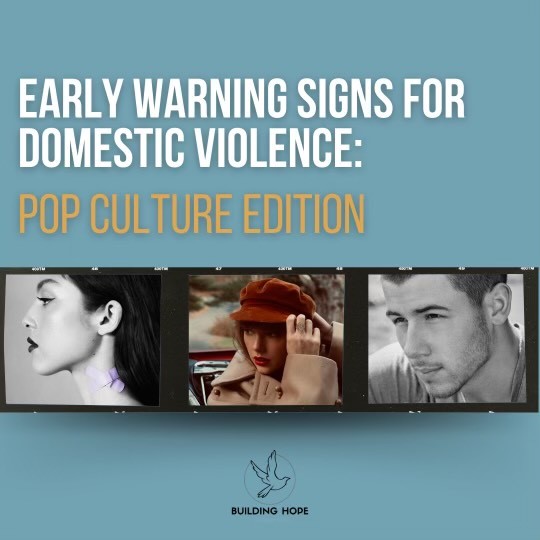
Early Warning Signs: Pop Culture Edition
There are many warning signs of abuse apparent early in relationships. In this post we will review only three, but I will include a longer list at the end of this section. This list is adapted from Bancroft’s previously mentioned book, Why Does He Do That: Inside the Minds of Angry and Controlling Men (2002).
My clients, friends, and family will tell you that I have a song for everything. Early warning signs of domestic violence are no exception, so I will be borrowing from Oliva, Nick, and Taylor to help illustrate the following behaviors to watch out for:
- Disrespect towards past partners
- Controlling and Possessive behavior
- Self-centeredness
Disrespect Towards Past Partners

Olivia Rodrigo, who we all know is wise beyond her years, says it well in her recent hit “Vampire” (Rodrigo, 2023):
Every girl I ever talked to told me you were bad, bad news
You called them crazy
God, I hate the way I called them crazy too
Listen carefully to how a potential partner speaks about their exes (Bancroft, 2002). If they use degrading or condescending language about someone that they claim they used to have feelings for, what will stop them from using this language about or towards you in the future? Some resentment or anger toward an ex is normal and to be expected. If you notice malice – if it feels like poison is dripping from your partner’s lips – when they speak of their ex, it may be a sign of danger to come.
Controlling and Possessive Behavior

It may be exciting or enticing to meet someone who takes charge, especially in a dating world filled with “I dunno, what do you want to do?” However, early signs of controlling behavior can be a warning sign for potential domestic violence down the road (Bancroft, 2002). At a minimum, control looks like your partner not taking your opinions into account. At worst, it looks like not being able to make independent decisions for fear of retaliation.
In pop culture we romanticize jealousy. Nick Jonas’s song “Jealous” received international praise and is the boyband singer’s most popular solo song (Billboard, 2023). In this song Jonas proudly tells his partner that he does not like her social media posts, stating (Jonas, Nolan, & Wilcox, 2014):
I wish you didn’t have to post it all
I wish you’d save a little bit just for me
Protective or possessive, yeah
Call it passive or aggressive
While many of us grew up daydreaming about Nick Jonas claiming us as his own (guilty as charged), a deeper look at his lyrics shows a pattern of desiring ownership over his partners. (I would like to point out that this pattern is mostly in his solo albums. Kevin really keeps him in check in the group projects).
It is easy to confuse jealousy with passion or with love in a partnership. If your partner’s controlling and possessive behavior is beginning to impact your relationship or your individuality, consider a possibility of abuse.
Self-Centeredness
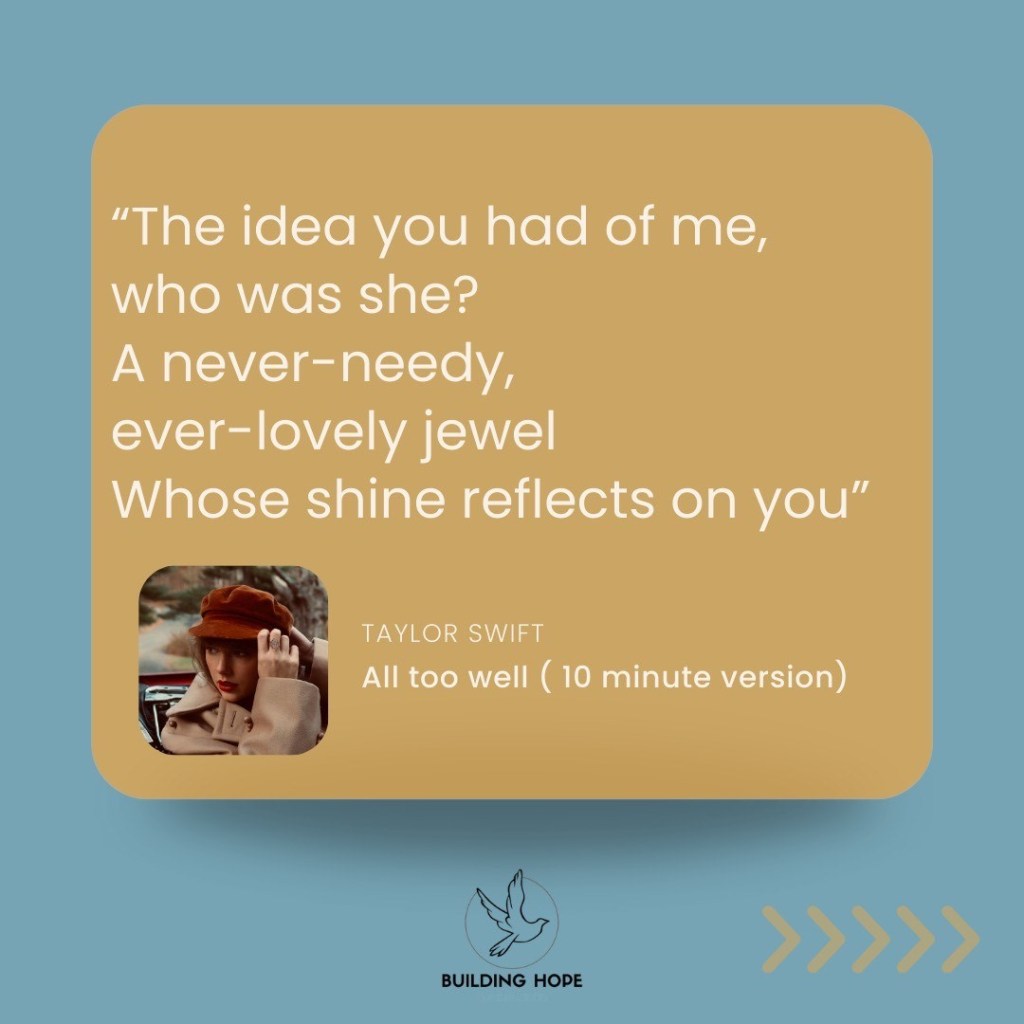
As I mentioned earlier, the abuser has an idyllic view of romantic relationships in which all of their needs are met by you, and you have no needs at all (Bancroft, 2002). Taylor Swift speak to this concept in the 10 Minute Version of “All Too Well” (looking at you, Jake Gyllenhaal) (Swift & Rose, 2021):
The idea you had of me, who was she?
A never-needy, ever-lovely jewel whose shine reflects on you
Self-centeredness may be a sign of entitlement, which is a key component of abuse (Bancroft, 2002). If your new partner seems to be more interested in the idea of you than you as an actual human being, it may be time to move on.
Other Potential Signs
The following list is adapted from Why Does He Do That?: Inside the Minds of Angry and Controlling Men (Bancroft, 2002). While a single instance of one of the examples below may be problematic, abuse results from a pattern of these behaviors being used to control you.
- They are disrespectful towards you
- They do favors that you do not want and that make you feel uncomfortable
- Nothing is their fault
- They pressure you – for sex, for commitment, to engage in drug or alcohol use
- They are intimidating when they are angry
- They have double standards
- He has negative attitudes women (for those in hetero-presenting relationships)
- They treat you differently around other people
- They appear to be attracted to vulnerability
In Summary
Abuse is a series of behaviors used to control the victim. Abuse in relationships is referred to as domestic violence or intimate partner violence. The word violence does not solely refer to physical injury – Violence in this case can come from intimidation, manipulation, or anything else that creates a power imbalance in a relationship and causes the victim to lose their independence (Domestic Violence Ended, 2023).
Whether you read this article to better educate yourself in order to help your community, a loved one, or yourself, today you have taken a step towards ending domestic violence. I am so proud to be on this journey with you. If you are questioning if you are in an abusive relationship or need help ending one, reach out to the Domestic Violence Hotline or one of the resources listed below.
Resources
General Hotlines
National Domestic Violence Hotline – thehotline.org or 1-800-799-SAFE (7233)
10 to 10 Helpline – Available 10am – 10pm, every day at 10to10helpline.org or 877-898-3411
Domestic Violence Ended (DOVE) – Serves the South Shore of Massachusetts at
Dovema.org or 617-471-1234
SafeLink Massachusetts Statewide Hotline – Massachusetts 24/7 domestic violence hotline at 1-877-785-2020
Jane Doe Inc. (JDI) – Serves the Commonwealth of Massachusetts at www.janedoe.org or 617-248-0922
Legal
Mass Legal Help – You may be able to get free legal help in Massachusetts at www.masslegalhelp.org/domestic-violence
Housing
Affordable Units for Rent in Massachusetts – www.mass.gov/info-details/affordable-units-for-rent
Brookview House – Helping homeless women and children in Massachusetts at https://brookviewhouse.org/ or 617-265-2965
Family and Community Resources – State that you a survivor of domestic violence in need of housing assistance when you reach out at www.fcr-ma.org/
Minority Communities
Fenway Health – Free counseling and advocacy for the LGBTQ+ community at fenwayhealth.org/care/behavioral-health/violence-recovery/ or 617-927-6250
Abused Deaf Women’s Advocacy Services (ADWAS) – https://www.adwas.org, or hotline@adwas.org, or 855-812-1001
Asian Task Force Against Domestic Violence – https://www.atask.org/ or 617-338-2355
SafeLink Massachusetts Statewide Hotline – TTY 1-877-521-2601
References:
Bancroft, L. (2002). Why does he do that: Inside the minds of angry and controlling men. Berkley.
Billboard. (2023). Nick Jonas. Billboard. https://www.billboard.com/artist/nick-jonas/
Center for Disease Control and Prevention. (2022). Fast facts: Preventing intimate partner violence. Center for Disease Control and Prevention. https://www.cdc.gov/violenceprevention/intimatepartnerviolence/fastfact.html
Domestic Violence Ended (2023). Defining domestic violence, Domestic Violence Ended. https://www.dovema.org/general-resources
Jonas, N., Nolan, S, & Wilcox, S. (2014). Jealous [Recorded by N. Jonas] on Nick Jonas.
National Coalition Against Domestic Violence. (2018). Domestic violence and the LGBTQ Community. National Coalition Against Domestic Violence. https://ncadv.org/blog/posts/domestic-violence-and-the-lgbtq-community
Rodrigo, O. & Nigro, D. (2023). Vampire [Recorded by O. Rodrigo] On Guts.
Swift, T & Rose, L. (2021). All Too Well (10 Minute Version) (Taylor’s Version) [Recorded by T. Swift] on Red (Taylor’s Version).
World Health Organization (2021). Violence against women, World Health Organization. https://www.who.int/news-room/fact-sheets/detail/violence-against-women

 Building Hope Counseling Services
Leave a comment